The Gift of Presence: Why More Moms Are Choosing Time Over the Traditional 9-to-5
There is a quiet heartbreak many mothers know very well.
It is not always dramatic. It does not necessarily look like a breakdown. Often, it looks like competence. Routine. Efficiency. A woman doing what needs to be done, showing up, keeping life moving, getting through the day.
But underneath it, there is a question that keeps returning:
Why does building a secure future so often mean missing the life I am trying to build it for?
That is the tension so many mothers live with. They want to be present. They want financial independence. They want meaningful work. They want to feel like themselves. And yet the traditional 9-to-5 often forces all of those things into conflict, as if a woman must choose one identity at the expense of another.
For many moms, that is where everything begins to shift.
Not because they stop caring about work.
Not because ambition disappears.
Not because motherhood suddenly erases every other part of who they are.
But because time becomes impossible to ignore.
And once a mother starts measuring life not just by income, titles, or responsibilities, but by whether she is actually there for the moments that matter, her whole definition of success begins to change.
When “normal” no longer feels acceptable
The traditional work model is treated as if it were neutral. As if it simply exists and everyone must find a way to adapt.
But mothers know better.
They know that “normal” often means rushing in the morning, watching the clock all day, collecting children tired and distracted, and trying to squeeze connection into whatever energy remains. They know what it feels like to come home already depleted. To hear about your child’s day instead of living any part of it with them. To feel like family life happens in the margins of a schedule designed by someone else.
This is the point where a lot of women stop asking, “How can I cope better?” and start asking a much more important question:
Why am I treating this structure as inevitable if it no longer fits the life I want?
That question is powerful because it interrupts the script.
And the script is strong.
Be grateful.
Keep going.
Stay practical.
Don’t ask for too much.
Don’t expect work to fit your family.
Just become more efficient inside the same exhausting system.
But some women reach the point where efficiency is no longer the answer.
Because the issue is not poor time management.
The issue is that the shape of life itself has started to feel wrong.
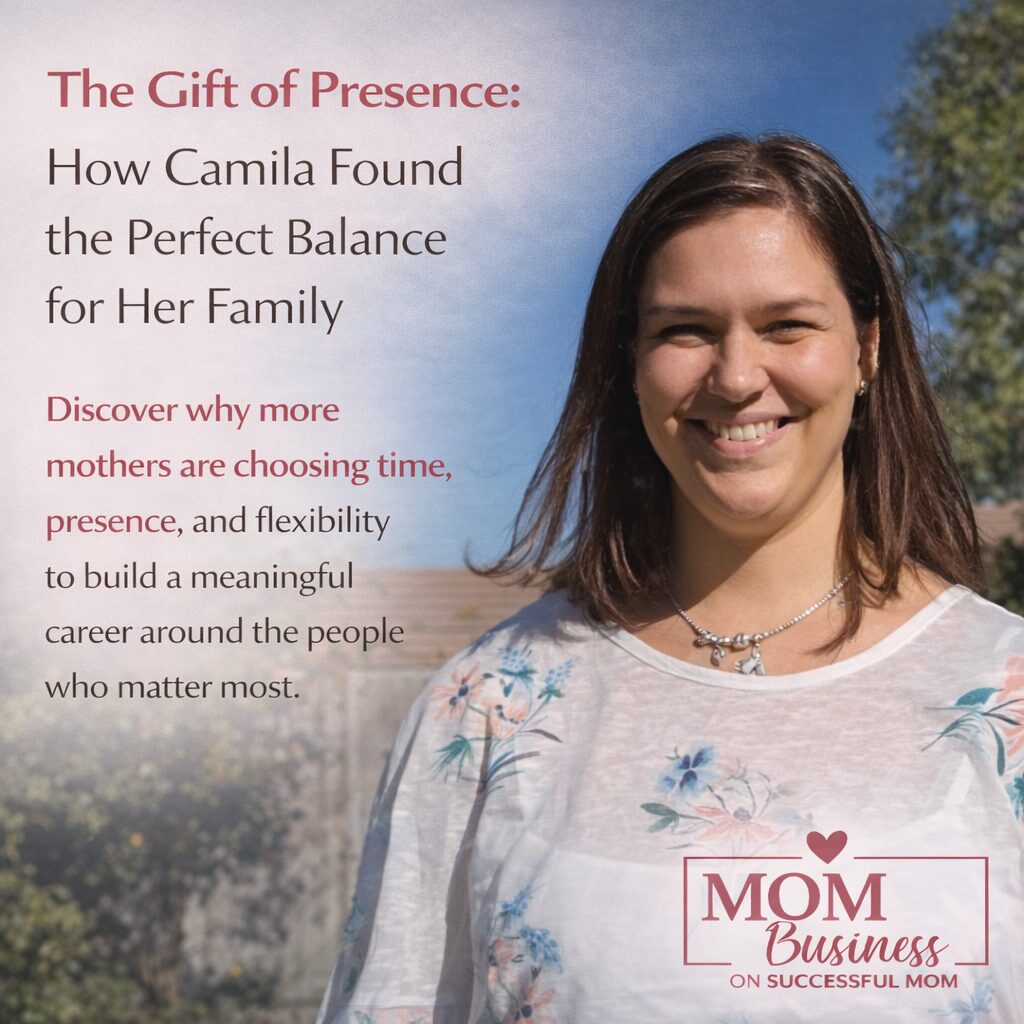
Prescribed Freedom: How Camila Benoual Found the Perfect Balance for Her Family
Every mother knows the silent struggle: the desire to be present for every milestone in your children’s lives versus the necessity (and personal drive) to have a career and financial independence. For Camila Benoual, this wasn’t just a thought—it was a daily reality that led her to seek a different path.
In her inspiring “Faces of Forever” story, Camila shares how she transitioned from the traditional constraints of the working world to a life of prescribed freedom.
The Turning Point for a Modern Mom
Camila’s journey didn’t start with a desire for a massive empire, but with a simple, profound need: Time. She wanted to see her children grow up, not just hear about their day after getting home from a long shift. Like many women in our community, she realized that the traditional 9-to-5 model often forces moms to choose between a paycheck and a presence.
“The Forever Living opportunity has given me more time to spend with my family and see my children grow up.” — Camila Benoual
The real turning point is often simpler than people think
People often assume major life changes begin with some huge moment of revelation.
Sometimes they do.
But often, the turning point is much quieter.
It is the realization that you do not want to keep hearing about your children growing up from the other side of a workday.
It is the realization that your schedule is always demanding your best hours.
It is the realization that presence has become more valuable to you than the appearance of having it all under control.
That is why this kind of story resonates so strongly.
Because it is not really about a woman wanting a massive empire, a glamorous lifestyle, or a dramatic reinvention. It is about something much more human: wanting enough time to actually live the life she cares about. Wanting to see her children grow up. Wanting to stop feeling like presence is something she has to earn.
And honestly, that is not a small desire.
It is one of the most intelligent desires a mother can have.
Presence is not a luxury
Somewhere along the way, many women were taught to treat presence as a bonus.
A nice extra.
A privilege.
Something you get if work is flexible enough, if your employer is kind enough, if your calendar is quiet enough, if the season is easy enough.
But presence should not be framed as a luxury.
Presence is the texture of family life.
It is the ordinary conversation after school.
The unrushed moments.
The ability to notice things.
The space to be emotionally available instead of constantly mentally elsewhere.
The relief of not always being pulled away by a clock.
Children may not remember every detail of your job. But they feel your rhythm. They feel whether you are available, hurried, stretched, or half-present. Mothers feel that too, often with painful clarity.
That is why so many women reach the point where they no longer want a career that only looks good on paper. They want one that feels right in real life.
Why women are rethinking the 9-to-5
The classic work model has always asked for a lot. But for mothers, it often asks for something more specific: the most alive hours of the day.
Morning routines.
School drop-offs.
Afternoons.
Mental bandwidth.
Family ease.
And then it offers back a paycheck, stability, and the social approval of doing what sensible adults are supposed to do.
That trade may work for some people. But for many moms, it starts to feel increasingly unfair.
Why should financial independence require emotional absence?
Why should meaningful work automatically come wrapped in inflexible hours?
Why should the only “serious” path be the one that makes family life harder?
These are not rebellious questions. They are honest ones.
And once a woman starts asking them, it becomes much harder to settle for a version of success that keeps taking from the very life she values most.
The dream is not less ambition. It is better alignment.
This part matters.
A lot of mothers are not looking for a way to do less. They are looking for a way to stop living in pieces.
They still want purpose.
They still want growth.
They still want to contribute, build, achieve, and create.
They still want income and independence.
What they do not want is a life where those things are always set against their family.
They do not want every professional step forward to feel like a step away from home.
That is why flexible, family-centered business models can feel so powerful. Not because they promise ease, but because they offer alignment. They make it possible to work around children’s schedules, build something financially meaningful, and do it in a way that feels more integrated than the old model ever did.
That changes the emotional equation.
Suddenly, work no longer has to be the force that steals time. It can become something built around the life you actually want.
Building differently changes everything
One of the most refreshing things about this kind of path is that it does not start with “blow up your life and become someone else.”
It starts smaller.
With a mother looking honestly at what matters.
With the realization that time is not a side issue.
With the decision to stop pretending the old structure is the only respectable option.
From there, something shifts.
Instead of trying to squeeze family into the leftovers of a rigid career, she begins to build a model that fits real life. A model that can move around school schedules, ordinary days, unpredictable needs, and the rhythms of motherhood. A model that still allows financial growth, but not at the cost of constant absence.
And that is where so many women feel the emotional click.
Not because life becomes perfect.
But because it becomes more theirs.
The phrase that matters most: “prescribed freedom”
There is something deeply telling about that phrase.
Prescribed freedom.
It sounds almost like a correction. As if freedom itself has become the remedy.
Not chaos.
Not escapism.
Not “doing whatever you want.”
Freedom in the adult sense.
Freedom to decide your hours.
Freedom to work in a way that reflects your values.
Freedom to stop apologizing for wanting family life to matter.
Freedom to build income without always being owned by someone else’s timetable.
That kind of freedom is not selfish. It is stabilizing.
And for many mothers, it is exactly what makes them feel more grounded, more present, more capable, and more hopeful.
FAQ
Why do so many mothers feel torn between career and family?
Because traditional work structures often force women to split themselves between being present at home and being fully available at work. Many mothers do not lack ambition — they lack a model that allows both ambition and presence to coexist. That tension creates guilt, exhaustion, and a constant feeling of being pulled in two directions. Over time, many women start looking for a path that feels more humane.
Why does time become such a big issue for moms?
Time becomes central because motherhood changes what success feels like. A paycheck still matters, but so does being there for school runs, conversations, milestones, and ordinary moments. Many mothers realize that the real pain is not just working hard, but missing too much while doing it. That is why time is not a minor detail. For many women, it becomes the reason everything else gets re-evaluated.
Can a mother stay ambitious and still choose a family-centered career?
Yes, absolutely. Wanting more presence at home does not mean giving up ambition. Many mothers still want growth, income, purpose, and meaningful work. What changes is the shape of success. Instead of accepting a career that constantly clashes with family life, they look for one that supports both. The goal is not to become less driven, but to build in a way that feels more aligned and sustainable.
What makes a flexible business model so appealing for moms?
A flexible business model gives mothers something the traditional 9-to-5 often does not: room to breathe. It allows work to fit around children’s schedules, changing family needs, and the rhythms of real life. That flexibility is appealing not because moms want to do less, but because they want more control over how their time is spent. It creates the possibility of earning, growing, and being present at the same time.
What does the “perfect balance” really mean for mothers?
For most mothers, perfect balance does not mean a flawless routine or a stress-free life. It means a life where work no longer constantly competes with family. It means having enough flexibility to be present, enough purpose to feel fulfilled, and enough financial stability to feel secure. In that sense, balance is less about perfection and more about finally building a life that feels right from the inside.
A different definition of success
Maybe that is what this really comes down to.
Success used to mean achievement at any cost.
Now it means something else.
It means being there.
It means financial security without emotional disappearance.
It means building something real without sacrificing the small moments that make life feel full.
It means choosing a path that reflects not just what looks good from the outside, but what actually feels good to live inside.
For many mothers, that is the real upgrade.
Not more status.
Not more noise.
Not another title that sounds impressive in a bio.
Just a life where family and ambition no longer have to fight for space.
And maybe that is the most beautiful part of all:
A mother does not have to choose between being present and building something meaningful.
She may simply need a model that was designed with real life in mind.

passive income with Pinterest

The Gift of Presence: How Sarah Built a Thriving Career Around Her Family