Pinterest often looks harmless at first glance.
A few pretty images. Some inspiration. Recipes. Home decor. Fashion. Ideas. Nice, yes — but not necessarily like a platform that can seriously help you grow traffic, build visibility, or support a real business.
And that is exactly where many beginners misunderstand it.
Pinterest is not just social media. Pinterest is a visual search engine. That means people do not only scroll mindlessly for entertainment. They use the platform to search for ideas, answers, solutions, and step-by-step guidance.
That is what makes Pinterest marketing so powerful — especially for beginners.
You do not need to be famous. You do not need a huge audience. And you do not need to spend all day online. If you understand how Pinterest works, you can build a system step by step that creates long-term visibility and sends people to your blog, website, freebie, newsletter, or offer.
In this article, I will show you how Pinterest marketing works, why it is such a smart platform for beginners, and how to build a strong foundation from the start.
Download the Free Pinterest Blueprint
If you do not want to just understand Pinterest in theory but actually start using it strategically, the free 7-day Pinterest Blueprint is a strong next step.
Inside, you will learn how to:
- build your Pinterest profile strategically
- find the right keywords
- plan professional pins
- organize your content clearly
- and use Pinterest step by step as a real business tool
The blueprint is especially helpful for beginners and moms who have limited time but still want to build something of their own.
Pinterest marketing means creating and organizing content in a way that helps it get found, clicked, and saved on Pinterest.
The big difference compared to many classic social media platforms is this: Pinterest is driven by search intent. People type in keywords because they are actively looking for something specific. They might be searching for a tutorial, a solution to a problem, an idea for their business, or inspiration for a project they want to start.
That is important because it means you are not only relying on random attention.
If your content matches the search terms your target audience is using, your pins can still be found weeks or even months later. That is one of the biggest reasons Pinterest is so valuable for people who want sustainable visibility.
Pinterest marketing is not just about posting attractive graphics. It is about creating useful, relevant content that matches search behavior and brings the right people to your content.
Many beginners feel overwhelmed by other platforms.
On Instagram, you are expected to post regularly, stay visible, use reels, react quickly, show personality, and keep up with trends before they disappear again. That can become exhausting very fast.
Pinterest works more calmly.
Of course, Pinterest still requires strategy. But you do not need to be live and active all the time. You can prepare content, structure your topics, and gradually build a system that is not completely dependent on daily presence.
That makes Pinterest especially attractive for beginners for several reasons.
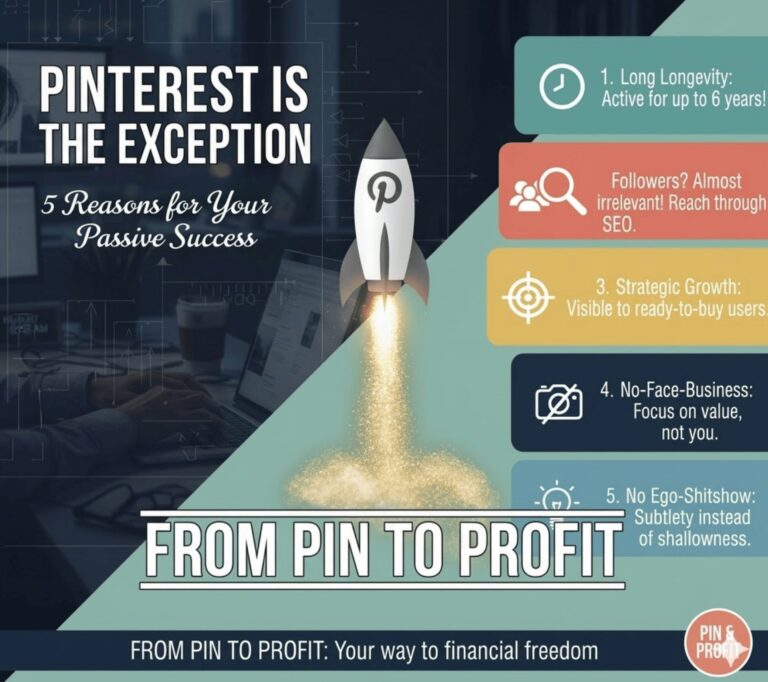
1. Pinterest rewards relevance, not just reach
You do not need thousands of followers to be found. What matters much more is whether your content matches what people are actually searching for.
2. Content has a longer lifespan
A pin can still generate clicks and visibility long after it has been published. That is a huge advantage compared to platforms where content often disappears quickly.
3. Pinterest is easier to plan
If you know your topics and understand what your audience is looking for, you can build your content much more strategically and calmly.
4. Pinterest works well for blogs, websites, freebies, and offers
Pinterest is not just for pretty visibility. It can actively help move people to your website, your article, your lead magnet, or your offer.
If you want to build long-term visibility instead of constantly running in a content hamster wheel, Pinterest is a very smart place to start.
Pinterest does not work equally well for every topic, but it can be very strong for many content areas.
It is especially useful for themes like:
- online business
- health and wellness
- beauty and self-care
- food and recipes
- family and everyday life
- DIY and creative topics
- home and interior
- personal growth
- travel
- coaching, courses, and digital products
In general, Pinterest works well when people are searching for ideas, solutions, step-by-step guidance, or inspiration.
If your content is extremely spontaneous, purely entertainment-driven, or not very searchable, Pinterest may not be your strongest main channel. But for most content-based businesses, it can be a very powerful support system.
Step 1: Create a Pinterest Business Account
If you want to use Pinterest strategically, you should not rely on a private account. You need a Pinterest business account.
Why? Because a business account gives you access to features that matter if you want to grow, such as:
- analytics
- advertising options
- professional profile settings
- business-related profile information
A business account also makes your profile look more professional and helps you treat Pinterest as a real marketing channel instead of just a personal idea board.
If you already have a private Pinterest account, you can often convert it. Or you can simply create a new business account from scratch.
This first step may sound simple, but it is important. If you want to use Pinterest seriously, you need a clean foundation.
Step 2: Understand Your Target Audience
This is the point many beginners underestimate.
You can create the most beautiful pins in the world, but if they speak to the wrong audience, they will not do much for you.
That is why you should ask yourself early on:
- Who do I want to reach?
- What is this person struggling with?
- What kind of solutions are they looking for?
- Which keywords would they type into Pinterest?
- What do they actually care about?
Pinterest marketing does not begin with design. It begins with understanding your audience.
Once you know what your ideal reader or customer is searching for, you can create much more relevant content. And that is exactly what improves visibility later.
Step 3: Do Simple Keyword Research
Pinterest is a search engine. That means keywords are not optional. They are the foundation.
Keywords are the terms people type into the Pinterest search bar. If you know those terms, you can optimize your content accordingly.
You do not need to overcomplicate this in the beginning. A simple process is enough:
- collect main keywords around your topic
- use the Pinterest search bar
- pay attention to related suggestions
- write down terms that appear repeatedly
For example, if your topic is Pinterest marketing, your keywords might include:
- Pinterest marketing
- Pinterest marketing for beginners
- Pinterest tips
- Pinterest business account
- grow on Pinterest
- Pinterest strategy
- Pinterest blog traffic
The important thing is to use phrases people actually search for — not just words you personally think sound nice.
Step 4: Optimize Your Profile
Your profile should not only look pleasant. It should immediately make it clear what your account is about.
That includes:
A clear profile name
Ideally one that makes your topic obvious.
A readable bio
Short, relevant, and easy to understand. A poetic fog machine may sound deep, but it usually does not generate clicks.
A professional profile image
It does not need to look like a magazine cover, but it should feel trustworthy and polished.
A linked website
If you have a blog, website, or landing page, connect it properly.
Your profile is the basis of your credibility. People should understand within seconds what they can expect from you.
Step 5: Create Strategic Boards
Many beginners make the mistake of publishing random pins before building a clear board structure.
Boards matter because they create order. They help Pinterest understand what your profile is about, and they help users understand your content faster.
Your boards should:
- be clearly focused
- have strong titles
- include relevant keywords
- not be too broad or too chaotic
For example, instead of naming a board “Tips,” something like “Pinterest Marketing Tips for Beginners” is much stronger.
The clearer your structure, the easier it is for Pinterest — and for your audience.
Step 6: Create Pins People Actually Want to Click
Now we come to the part many people first associate with Pinterest: pin design.
Yes, design matters. But not in the way many assume.
A good pin does not just need to be beautiful. It needs to be clear, relevant, and clickable.
Strong pins usually include:
- readable text overlays
- one clear message
- a clean, attractive design
- an obvious benefit
- a layout that works well on Pinterest
Ask yourself this every time:
Why should someone click this specific pin?
A pretty image without a clear reason often gets ignored. A clear and useful pin with a strong message usually performs much better.
Step 7: Link Your Pins to Meaningful Goals
Pinterest is not a vanity platform. You are not building this just to collect impressions and admire your own graphics.
Pinterest becomes powerful when it sends people somewhere useful.
Every pin should ideally lead to a clear destination, such as:
- a blog post
- a landing page
- a freebie
- a newsletter signup
- a product
- an offer
- another meaningful entry point into your business
If people can find you on Pinterest but have nowhere useful to go next, you are wasting potential.
Pinterest becomes much more effective when your content leads people deeper into your world.
Step 8: Plan Consistently Instead of Pinning Randomly
You do not need to upload ten new pins every day to make progress on Pinterest. What matters more is consistency and structure.
Beginners especially benefit from having a simple plan instead of pinning randomly whenever something pops into their head.
For example:
- Which topics are you covering?
- Which blog posts or offers do you want to promote?
- Which keywords fit those topics?
- Which pins do you want to create this week?
It is almost always better to work consistently and strategically than to do everything in a burst of motivation and then disappear for weeks.
Pinterest likes clarity and consistency. Not chaos.
Step 9: Watch What Is Working
Pinterest is not a platform you set up once and then never look at again.
You do not need to obsess over every number, but you should pay attention to what happens.
Helpful questions include:
- Which pins get impressions?
- Which pins get clicks?
- Which topics perform especially well?
- Which keywords seem relevant?
- Which content brings visitors?
Beginners learn the most when they do not only create, but also understand what actually works.
This is not magic. It is just strategic thinking.
Beginners often make similar mistakes. That is normal. But you can save yourself some frustration by recognizing them early.
1. Treating Pinterest like Instagram
Pinterest is not made for spontaneous lifestyle snippets. It works through search and structure.
2. Ignoring keywords
Without keywords, Pinterest has a harder time understanding and categorizing your content.
3. Creating unclear boards
If your profile feels messy, it loses strength and direction.
4. Focusing only on pretty design
Pretty is nice. Clear and relevant is stronger.
5. Pinning without a goal
Pins without links, strategy, or a next step waste potential.
6. Giving up too quickly
Pinterest is usually not an instant-results platform. Many people quit long before their content has even had time to fully gain momentum.
This is a fair question, and the honest answer is: it takes some patience.
Pinterest is usually a long-term channel. It can take weeks for content to be fully indexed and for first developments to become visible. But in return, the platform is often much more sustainable than many other channels.
If you start Pinterest expecting to go viral tomorrow, you will probably be disappointed.
If you build Pinterest as a strategic system that grows step by step, the picture looks very different.
Pinterest is not a sprint. It is more like a calm, structured build.
Download the Free Pinterest Blueprint
If you do not want to just understand Pinterest in theory but actually start using it strategically, the free 7-day Pinterest Blueprint is a strong next step.
Inside, you will learn how to:
- build your Pinterest profile strategically
- find the right keywords
- plan professional pins
- organize your content clearly
- and use Pinterest step by step as a real business tool
The blueprint is especially helpful for beginners and moms who have limited time but still want to build something of their own.
Is Pinterest marketing suitable for beginners?
Yes, Pinterest is very suitable for beginners because it does not rely as heavily on real-time activity or a large following. Since Pinterest works like a search engine, helpful content can still be found long after it is published. That gives beginners the chance to build visibility step by step through relevant keywords, clear boards, and useful pins instead of needing constant daily online presence.
Do I need a website for Pinterest marketing?
No, a website is not technically required to start on Pinterest, but it is highly recommended if you want real business results. Pinterest becomes much more powerful when your pins lead to something valuable such as a blog post, landing page, free resource, or offer. Without that next step, you may get visibility, but you are far less likely to turn that visibility into traffic, leads, or long-term growth.
How often should I pin on Pinterest?
What matters most on Pinterest is consistency, not frantic activity. You do not need to pin all day or upload huge amounts of content to get started. A structured and realistic plan is usually much more effective than random bursts of posting. If you create relevant pins regularly and keep your topics clear, Pinterest can understand your content better and help your visibility grow over time.
How do I find the right keywords?
A good way to find Pinterest keywords is to start with the search bar itself. Type in your main topic and look at the suggestions Pinterest gives you, because those often reflect real user searches. You can also watch for recurring phrases in your niche and collect topic-related keywords that match what your audience is looking for. The goal is always to use searchable phrases, not just clever wording.
Is Pinterest more short-term or long-term?
Pinterest is generally a long-term marketing channel, and that is one of its biggest advantages. Unlike platforms where content disappears quickly, Pinterest content can keep generating impressions and clicks long after it was published. That means growth is often slower at first, but it can become much more sustainable over time. Pinterest is usually better for steady momentum than for fast attention spikes.
Pinterest often looks more complicated at the beginning than it really is.
In reality, you do not need a perfect strategy, a huge team, or endless time to get started. What you need is a clear entry point.
Once you understand that Pinterest is not a traditional social media platform but a search engine, everything becomes easier. Then the focus shifts away from being constantly present and toward building relevant, structured content.
A business account, an optimized profile, clear boards, the right keywords, strong pins, and a realistic plan — that is how effective Pinterest marketing grows step by step.
You do not have to do everything perfectly at once.
But you should start cleanly.
Because that is often the real difference between random pinning and actual growth.
Download the Free Pinterest Blueprint
If you want to stop guessing and start building your Pinterest strategy in a more structured way, the free 7-day Pinterest Blueprint is a great next step.
Inside, you will get a clear roadmap that helps you:
- build your Pinterest profile strategically
- find the right keywords
- create professional pins
- organize your content more effectively
- and use Pinterest as a business tool step by step
Download your free Pinterest Blueprint now and start with more clarity, more structure, and less overwhelm.

Work From Home Business for Moms: Why High-Achieving Women Leave Corporate Life

Work From Home Business for Moms: Why Juliana Left Luxury Retail for More Family Freedom